Queer Places:
Wellesley College (Seven Sisters), 106 Central St, Wellesley, MA 02481
Machpelah Cemetery, 71 North Street, Le Roy, New York 14482 United States
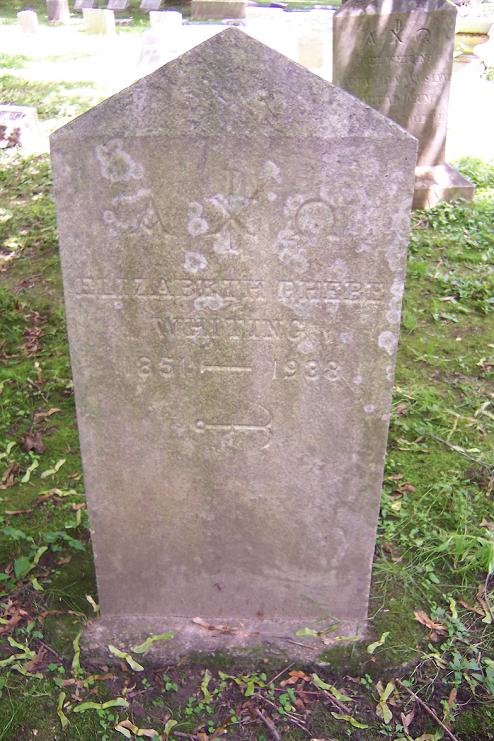 Elizabeth Phebe Whiting (1851-1933) was an essential presence in the early academic and social life of Wellesley College, serving as the lifelong companion and domestic
anchor to her older sister, pioneer physicist and astronomer Sarah Frances Whiting.
Elizabeth Phebe Whiting (1851-1933) was an essential presence in the early academic and social life of Wellesley College, serving as the lifelong companion and domestic
anchor to her older sister, pioneer physicist and astronomer Sarah Frances Whiting.
Elizabeth was born in 1851 to Joel Whiting (1806–1877), a school principal and educator, and Elizabeth Lee Comstock Whiting (1818–1893). She grew up alongside her
older sister Sarah and two younger sisters, Mamie and Angeline, both of whom tragically died young in childhood/adolescence.
When Sarah Frances Whiting was appointed in 1876 to build the physics and astronomy programs at Wellesley College, Elizabeth joined her on campus. Elizabeth served on
the staff at Wellesley and handled domestic and social management for their joint household.
The sisters lived together in college dormitories and campus housing for decades before moving into the newly built Observatory House in 1906, adjacent to the Whitin
Observatory.
Together, the sisters established a reputation as warm, gracious, and deeply traditional hostesses. Their home served as an important hospitality hub for Wellesley
students, faculty, and visiting international scientists (such as William Thomson, Lord Kelvin).
Following Sarah’s retirement from Wellesley, the sisters moved together to Wilbraham, Massachusetts. Elizabeth cared for Sarah until her death in 1927.
As Sarah’s sole survivor and heir, Elizabeth ensured her sister's scientific legacy survived. In 1934, she donated a Hale spectrohelioscope to the Wellesley astronomy
department in Sarah's memory—a instrument that remained in active instructional use for generations of women astronomers. Elizabeth passed away in 1933.
Understanding Elizabeth’s living arrangement with Sarah requires looking through the lens of late 19th- and early 20th-century women’s higher education history:
During this era, many women academics lived in long-term, cohabitating partnerships with other female faculty—a social arrangement often termed a "Boston marriage". At
institutions like Wellesley, female professors were generally required or expected to remain unmarried to hold their faculty posts.
While many of Sarah's colleagues formed romantic or domestic unions with fellow female scholars, Sarah chose her primary, lifelong domestic partnership with her
unmarried sister, Elizabeth.
In the context of LGBTQ+ domestic history, sibling cohabitation among unmarried women served a unique role:
It provided the emotional closeness, shared finances, and domestic caretaking typical of a life partnership without breaking societal norms surrounding family
structures.
Living together on campus allowed Elizabeth to participate in the institutional community at Wellesley without holding a high-profile academic chair herself.
Elizabeth’s role as primary caregiver, host, and estate steward mirrors the roles played by partners in non-traditional unions of the era, ensuring both Sarah's personal
well-being and her historical memory.
References:
Other references:
- Wellesley College Archives (Margaret Clapp Library): Sarah Frances Whiting Papers (1847–1927)
- Wellesley College Archives (Margaret Clapp Library): Wellesley College Annual Reports & Yearbooks (Legenda)
- Wellesley College Archives (Margaret Clapp Library): Whitin Observatory Historical Records
- Glasscock, Jean, et al. (Eds.) — Wellesley College, 1875–1975: A Century of Women. Wellesley College, 1975.
- Creese, Mary R. S. — Ladies in the Laboratory? American and British Women in Science, 1800–1900: A Survey of Their Contributions to Research. Scarecrow Press, 1998.
- U.S. Federal Census Records (1860–1930)
- Massachusetts Town and Vital Records (1620–1988)
Support this project
This website is a passion project researched, developed, and funded entirely by me. If you find the content valuable and would like to help support the ongoing research and hosting costs, any contribution is deeply appreciated.
Thank you for keeping this independent resource alive!
My books on Amazon: Elisa Rolle's books
BACK TO HOME PAGE


